
Author: George Liacos
Every social problem we face is solvable—if we channel our collective ingenuity and strategic foresight. Nonprofits must move beyond tired funding narratives and embed sustainability deep into their organisational DNA. In today’s rapidly shifting environment, a sustainable business model isn’t merely about diversifying income; it’s about forging an integrated strategy that drives financial resilience, operational innovation, and genuine social impact.
In this post, I’ll define what this enhanced model for not for profits, explore the new and varied sources of income, and introduce a comprehensive three-axis model. This framework, which goes beyond the simple two-dimensional approach, helps us categorise our organisations into distinct archetypes. It’s time to move past buzzwords and embrace a blueprint for strategic action. Love your thoughts and suggestions on this!
Defining a Sustainable Business Model for Nonprofits
At its core, a sustainable business model for a nonprofit is not a patchwork of revenue streams—it’s a unified framework designed to secure long-term financial health, agility, and social value. Here’s what sustainability means in our context:
- Mission Coherence: Every decision, partnership, and revenue stream must reinforce the organisation’s core purpose. Financial success is inseparable from the ability to deliver on the mission.
- Resilience in Uncertainty: A sustainable model is built to withstand funding shocks, regulatory changes, and evolving community needs. It future-proofs the organisation.
- Value Beyond Dollars: Success is measured not solely in financial terms but in the tangible, lasting social change created for communities, beneficiaries, and stakeholders.
- Scalability: A robust model allows the organisation to expand its impact without compromising quality or diluting its core mission.
This isn’t a call for adopting the latest buzzwords—it’s a strategic imperative. Our business models must be as dynamic and resilient as the communities we serve.
Enhanced Sources of Sustainability
The quest for sustainability is rarely a one-path journey. Instead, it involves orchestrating a mix of income sources, each with its own strengths and challenges. Consider these additional sources:
- Earned Income:
More and more, nonprofits are embracing social enterprise models. Whether through fee-for-service programmes, product sales, or consulting services, earned income offers independence and market credibility. This approach not only diversifies revenue but reinforces the organisation’s value proposition. - Memberships, Subscriptions and Community Support:
Establishing recurring revenue through memberships or subscription models generates predictable cash flow and deepens stakeholder engagement. These models turn beneficiaries and supporters into long-term partners. - Impact Investing and Social Finance:
Innovative funding mechanisms like social impact bonds, programme-related investments (PRIs), and community investing are reshaping how nonprofits access capital. These sources not only provide vital funding but also align investor returns with measurable social outcomes—a genuine win–win. - Corporate Partnerships:
Strategic alliances with for-profit enterprises can unlock both financial resources and operational expertise. When built on shared values rather than mere transactions, these partnerships pave the way for creative solutions that benefit all parties. - Digital and Crowdfunding Initiatives:
The rapid evolution of digital platforms has opened up new avenues for online fundraising, micro-donations, and crowd-sourced projects. These methods can engage a broader audience, generate buzz, and inject dynamism into your fundraising efforts.
Each of these sources is a critical strand in the fabric of a sustainable business model. The challenge lies in weaving them together into a coherent strategy that balances risk with reward while ensuring our focus remains steadfast on creating real social impact.
Moving Beyond the 2×2 Matrix: The Three-Axis Framework
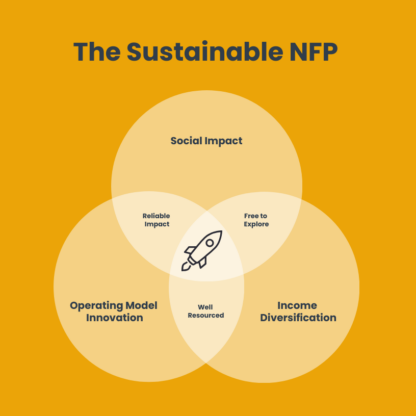
Traditionally, many have plotted nonprofit models on a two-axis matrix, weighing revenue diversification against operational innovation. While useful, this binary approach can oversimplify the complex realities of sustainability. I propose a three-axis model that captures:
- Income Diversification:
How robust and varied is the organisation’s revenue portfolio? This axis measures the reliance on multiple funding streams—from philanthropy and grants to earned income, digital initiatives, and corporate partnerships. - Operational Innovation:
This dimension assesses the extent to which an organisation embraces new technologies, agile practices, and creative operational methods. It’s not just about digital transformation—it’s about rethinking every facet of how we work, from board governance to service delivery. - Social Impact:
Often the missing piece in conventional models, this axis gauges the effectiveness with which the organisation’s activities create tangible, measurable change. It’s about ensuring that every innovative step and income channel ultimately enhances our impact on the community.
Visualising sustainability as a three-dimensional model provides a richer, more holistic perspective. Organisations can map their current position along these axes and pinpoint where strategic gaps exist. For example, you might score high on income diversification and operational innovation but lag in social impact. The insights from this model drive targeted investments—be it in new revenue channels, process re-engineering, or impact measurement systems—to achieve a truly balanced and resilient model.
Eight Archetypes: Navigating the Three-Axis Landscape
When we rank each axis into high or low performance, we can identify eight distinct archetypes across the nonprofit landscape:
- Conventional Mission-Guardians
Low Income Diversification | Low Operational Innovation | High Social Impact
These organisations remain rooted in traditional funding—largely relying on grants and philanthropy—while delivering strong mission outcomes. They may be cautious in adopting new technologies, yet their commitment to impact is unwavering. - Traditionalists
Low Income Diversification | Low Operational Innovation | Low Social Impact
Often legacy organisations, Traditionalists struggle to adapt to modern challenges. With limited revenue streams and little innovation, their overall impact is modest, exposing them to significant risks in a volatile funding landscape. - Innovative Dreamers
Low Income Diversification | High Operational Innovation | Low Social Impact
Brimming with creative ideas and agile practices, Innovative Dreamers lead operationally but haven’t yet translated these innovations into diversified revenue or substantial impact. Their challenge lies in monetising their innovative spirit. - Emerging Impact Leaders
Low Income Diversification | High Operational Innovation | High Social Impact
These organisations are on a promising trajectory. They deliver meaningful social outcomes and leverage modern practices but need to broaden their income streams. Their next step is to capitalise on their innovative strengths to secure financial resilience. - Revenue Maximisers
High Income Diversification | Low Operational Innovation | Low Social Impact
With a robust and varied revenue portfolio, Revenue Maximisers enjoy financial stability. However, without a corresponding investment in innovation and mission focus, their overall impact remains limited—they risk becoming financially secure yet strategically stagnant. - Steady Impact Practitioners
High Income Diversification | Low Operational Innovation | High Social Impact
These organisations have built a diverse income base and deliver significant social value. However, they might lag in embracing new operational practices. Their focus should be on integrating innovation to boost efficiency and adaptability further. - Resourceful Innovators
High Income Diversification | High Operational Innovation | Low Social Impact
Resourceful Innovators are financially robust and operationally agile, experimenting with breakthrough ideas. Their challenge is to channel these innovations into real, measurable social change and ensure that their creativity delivers tangible impact. - Trailblazing Changemakers
High Income Diversification | High Operational Innovation | High Social Impact
The gold standard in sustainability, Trailblazing Changemakers integrate a diversified revenue mix, continuous innovation, and exceptional social impact. They set new benchmarks by continuously refining their model and sharing best practices—an inspiring example for the entire sector.
Turning Theory into Action
Knowing where you stand is only the first step. To translate this three-axis framework into tangible results, nonprofits must adopt a rigorous yet flexible approach:
- Comprehensive Self-Assessment:
Start with a detailed audit of your revenue streams, operational practices, and impact metrics. Scenario planning and stress testing are vital to pinpoint vulnerabilities and opportunities. - Strategic Experimentation:
Rather than overhauling the system overnight, adopt a culture of iterative testing. Pilot projects—such as new digital fundraising platforms or streamlined service delivery models—allow for controlled risk-taking and agile refinement. - Collaborative Innovation:
Engage with a diverse range of stakeholders—from tech experts and financial advisors to community leaders—to harvest fresh perspectives and innovative ideas. These collaborations often yield scalable insights that can be integrated into the broader business model. - Continuous Learning and Adaptation:
In today’s fast-evolving landscape, the only constant is change. Regularly review performance metrics, gather stakeholder feedback, and recalibrate strategies. This adaptive mindset ensures that the organisation remains not only relevant but also a pioneer in driving social progress.
The Strategic Imperative for Global Leadership
Our mission is to reshape the conversation on nonprofit sustainability and push beyond conventional thinking. By embracing a three-axis framework that captures income diversification, operational innovation, and social impact, we equip ourselves to face both current challenges and future uncertainties.
This is not an academic exercise—it is a strategic imperative. As we position ourselves as global thought leaders in the social sector, we must be unafraid to question established norms, experiment with contrarian ideas, and drive meaningful change. The insights we generate today will set the benchmarks for tomorrow’s social impact.
Sustainability, when properly understood and executed, is not just about surviving in a competitive environment. It’s about thriving—by continuously evolving our business models to better serve our communities. Our future depends on models that are agile, resilient, and unapologetically innovative—a future where every initiative is designed not merely to weather the storm, but to catalyse lasting transformation.
Let’s be the pioneers who redefine what sustainability means in the nonprofit arena. By integrating a diversified income portfolio, embracing cutting-edge operational practices, and committing relentlessly to social impact, we can build organisations that are as dynamic and adaptive as the communities we serve.
Further Reading and References:
- Whitepaper: In Search of Sustainability – https://sparkstrategy.ac-page.com/whitepaper-in-search-of-sustainability
- Nonprofit Quarterly – https://www.nonprofitquarterly.org/
- Stanford Social Innovation Review – https://ssir.org/
If you enjoy reading articles like this and want to be kept updated with our free resources, join our newsletter. We will send regular, informative, and helpful content. You can also read more content here.